
Department of Plastic and Aesthetic Surgery at Viet Nhat General Hospital
Operating License Number: 3788/HNO-GPHD (Issued by the Hanoi Department of Health)


BLEPHAROPLASTY
UPPER | LOWER | BROW LIFT
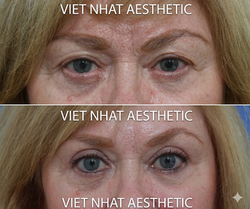
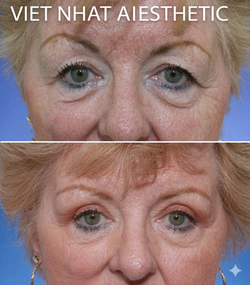
Blepharoplasty is an aesthetic eye procedure that removes excess skin and fat to rejuvenate the eye area.
-
Upper: Defines the eyelid crease, improves droopy lids, and creates a more youthful look.
-
Lower: Reduces under-eye bags, dark circles, and smooths the skin.
-
Brow lift: Elevates the brows, opens up the eyes, and softens forehead lines.
Enhances a more youthful, natural, and refreshed appearance.


Eyelid Structure
Double eyelid surgery is performed based on the key anatomical layers of the eyelid to create a well-defined, natural-looking crease:
-
Eyelid skin: The outermost, thin layer prone to aging. Excess skin is removed to improve sagging.
-
Orbicularis oculi muscle: Responsible for blinking and eye closure. A small portion may be adjusted if overly thick.
-
Orbital fat: Fat pads that can cause puffy eyelids. These may be partially removed or repositioned for a more refined look.
-
Orbital septum: A membrane that holds the fat in place; it is opened to access and treat excess fat.
-
Levator muscle: Controls eyelid elevation. In cases of Ptosis, it can be corrected to improve both vision and aesthetics.
-
Tarsal plate: The firm structural support of the eyelid, helping maintain and stabilize the new crease.
-
During the procedure, the surgeon removes excess skin, adjusts fat, and creates a connection between the skin, levator muscle, and tarsal plate to form a defined, balanced, and long-lasting eyelid crease.

Eyelid & Brow Surgery Techniques
-
Upper Eyelid Surgery (Upper Blepharoplasty):
Involves the eyelid skin, orbicularis oculi muscle, eyelid fat, orbital septum, levator muscle, and tarsal plate. The surgeon makes an incision along the pre-designed eyelid crease, removes excess skin, adjusts the muscle if necessary, and opens the septum to remove or reposition fat. In cases of Ptosis, the levator muscle is corrected. Finally, the skin–muscle–tarsal connections are secured to create a well-defined and long-lasting eyelid crease. -
Lower Eyelid Surgery (Lower Blepharoplasty):
Involves the lower eyelid skin, orbicularis oculi muscle, orbital fat, and septum. The procedure can be done through an external incision (if there is excess skin) or a transconjunctival approach (leaving no visible external scar). The septum is opened to treat fat pads (removal or redistribution), and the skin and muscle may be slightly tightened to smooth the under-eye area. -
Brow Lift (Eyebrow Lift):
Involves the skin, subcutaneous tissue, and forehead–brow muscles. It can be performed using endoscopic techniques (small incisions within the hairline) or direct approaches. The surgeon releases, lifts, and secures the brow in a higher position, helping to open up the eye area and rejuvenate the face.

Postoperative Care & Recovery
· Immediate Care (First 24–48 hours):
Apply cold compresses to reduce swelling and bruising
Keep the head elevated while sleeping
Avoid rubbing or touching the eyes
· Incision Care:
Wash hands before touching the eye area
Gently clean around the incision with a clean cloth or cotton
Apply prescribed antibiotic or healing ointments
Avoid makeup or skincare products near the incision until fully healed
· Medications & Monitoring:
Take pain relief and anti-inflammatory medications as prescribed
Use eye drops if instructed by the surgeon
Monitor for abnormal signs: excessive swelling, bleeding, severe pain, or discharge → contact your doctor immediately
· Activities & Lifestyle:
Avoid strenuous exercise or heavy lifting for 1–2 weeks
Do not wear contact lenses until cleared by the surgeon
Limit direct sun exposure to the eye area
· Recovery Timeline:
Swelling and bruising usually decrease within 7–10 days
Stitches (if non-dissolvable) are typically removed after 5–7 days
Crease formation stabilizes and natural results are visible after 4–6 weeks, with final results after 2–3 months

 |  |  |
|---|---|---|
 |  |  |